


AI-assisted grading for handwritten exams

Faster grading. Better feedback. You're in control.

Gradebird drafts rubric-aligned assessments for handwritten STEM work, so you can review every score, refine the feedback, and return clearer guidance to students sooner.

Handles multi-step reasoning, equations, diagrams, and partial credit.

PHYS 241 · EXAM 02 · QUESTION 4

8 / 10
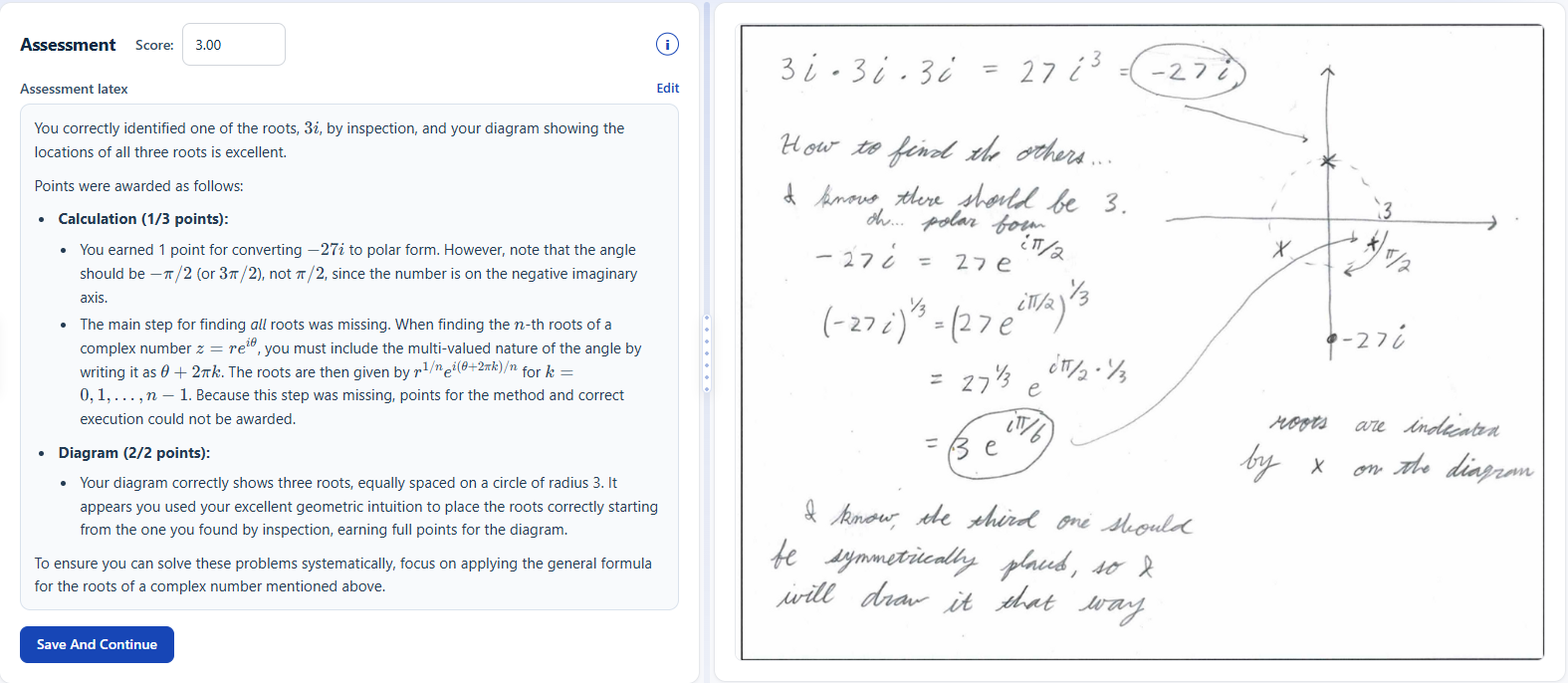
Gradebird assessment beside a student's handwritten mathematics response
Innovation Fueled by Arizona

Made in a physics department.
Ready for yours.

Start with the exam you already want to give.

A professor handing out a paper exam as university students begin their work

The paper stays familiar. The workflow around it gets lighter.

Same exam
feedback that teaches
  1. 01

    Build + print

    Give the exam on paper.

    Author in Gradebird or import what you already use. Set it up once, then print uniquely labeled packets that let Gradebird sort every scan automatically.
  2. 02

    Scan + assess

    Let Gradebird
    make the first pass.

    Scan completed exams. Gradebird organizes responses by question and generates detailed, rubric-aware assessment candidates.
  3. 03

    Review + release

    Approve with the evidence in view.

    See the student's work, score, reasoning, and feedback together. Revise anything. Release only when you are satisfied.

Same exam.Less grading overhead.Every final decision is yours.

Gradebird founder Sam Gralla in his University of Arizona office
Sam Gralla

Professor of Physics · University of Arizona
Founder · Gradebird

For Professors,
By a Professor

Sam Gralla wrote software professionally before becoming a physicist—and never really stopped. In 2024, he began Gradebird as a self-assessment tool that helped students learn from handwritten STEM work.

When AI became capable of reading that work holistically in early 2026, the classroom prototype became something more: a way to reduce grading overhead while preserving the judgment, context, and accountability of the instructor.

Innovation Fueled by Arizona
  1. Fall 2024First used in UA classes

    A student learning tool, built where it would be used.

  2. Jan 2026AI assessment arrives

    Handwritten reasoning becomes practical to assess holistically.

  3. May 2026University license signed

    A campus-built idea takes its next step outward.

  4. Summer 2026External pilots open

    Instructors beyond Arizona begin using Gradebird.

  5. Fall 2026Formal study planned

    Measuring workload, feedback quality, and student experience.

Privacy by design

Educational privacy is built into the product from day one.

FERPA-compliant

Created inside a university and ready for yours.

No tracking, ads, or data sales

Personal information is never used to train generalized models or target ads—and it is never sold.

Privacy policy

Hear from our pilot users

Ready to try it yourself?

Bring the power of AI to your next exam cycle

Join the pilot